Press release: Yango Group’s AI Routing Technology Saved Users 5 Million Hours in 2025 Close to 45,000 hours of total annual time saved by Namibians
todayFebruary 24, 2026
Photo: Yango
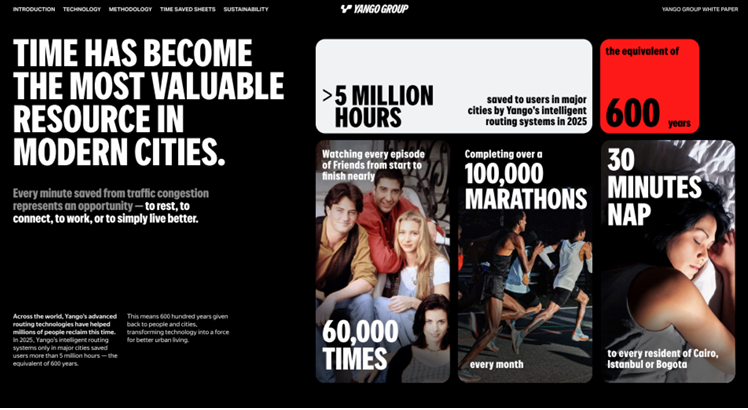
Windhoek, Namibia, 18.02.2026 – Yango Group, the global tech company digitalising urban services, today announced that its advanced AI-powered routing technologies saved urban commuters more than 5 million hours in 2025 across 20+ cities of its presence — the equivalent of 600 years of human time returned to communities.
The findings, based on an analysis of millions of Yango Ride trips in 2025, prove that intelligent routing delivers tangible quality-of-life improvements at scale, establishing AI-driven mobility as critical infrastructure for modern cities. Yango’s routing system leverages a sophisticated combination of machine learning models, real-time traffic data, and historical analysis to optimize every journey, processing multiple data streams simultaneously to calculate the most efficient route in milliseconds.
“Five million hours saved isn’t a tech metric — it’s proof that AI can solve real urban problems at scale,” said Adeniyi Adebayo, Chief Business Officer of Yango Group. “We’re demonstrating that the next generation of city infrastructure won’t be built with concrete and steel alone, but with data, algorithms, and intelligence embedded into everyday services.”
The research compared AI-optimized routes against static shortest paths that ignore live traffic conditions. Results showed significant time savings across varied urban landscapes.
For example, in Namibia, the total annual time saved was almost 45,000 hours while time saved per active passenger on Yango was over an hour. In Lima, users reclaimed over 1.1 million hours annually — the largest absolute saving among studied cities. Kinshasa residents saved an average of 6.48% per trip, while Guatemala City commuters experienced the highest efficiency gains at 6.99%. In Abidjan, the most active riders gained more than 2 hours per year individually. The cumulative effect represents 5 million hours returned to urban economies and communities in a single year.
The technology processes information about road characteristics, traffic light patterns, turn complexity, and predictive congestion modeling. The system’s self-learning architecture continuously improves accuracy by comparing predicted versus actual travel times, creating an evolving feedback loop that adapts to each city’s unique patterns.
Beyond time savings, intelligent routing contributes to broader urban sustainability goals. By minimizing idle time and optimizing traffic distribution, Yango’s AI technology helps improve fuel efficiency, lower emissions, and decrease localized congestion — core pillars of smart city development.
As cities worldwide grapple with growing populations and increasing motorization, Yango’s research underscores technology’s potential to address core infrastructure challenges while improving daily experiences for millions.
Operating across more than 35 countries in the Middle East, Africa, and LATAM, Yango Group builds services that form the foundation of smart urban ecosystems — digitizing city services and turning complex algorithms into accessible tools that help cities become more efficient, sustainable, and human-centered.
<iframe src="https://iframe.iono.fm/e/1745523?layout=modern" width="100%" height="170" frameborder="0" referrerpolicy="origin" loading="lazy"></iframe> The head of UNAIDS, Winnie Byanyima, has warned that recent cuts to international aid are putting decades of progress in the fight against HIV and AIDS at risk. Speaking to CNN’s Christiane Amanpour, Byanyima described the global HIV response as one of the […]
The Electoral Commission of Namibia says its former chairperson was never given or donated a government vehicle. In a media statement released on Friday, the ECN said a Toyota Landcruiser, bought for about 1.5 million dollars during the 2025/26 financial year, was allocated to the Chairperson’s office for official duties. […]